About
Dorota Dąbrowska returns, after many years, with her paintings. It is, in a sense, a return from beyond.
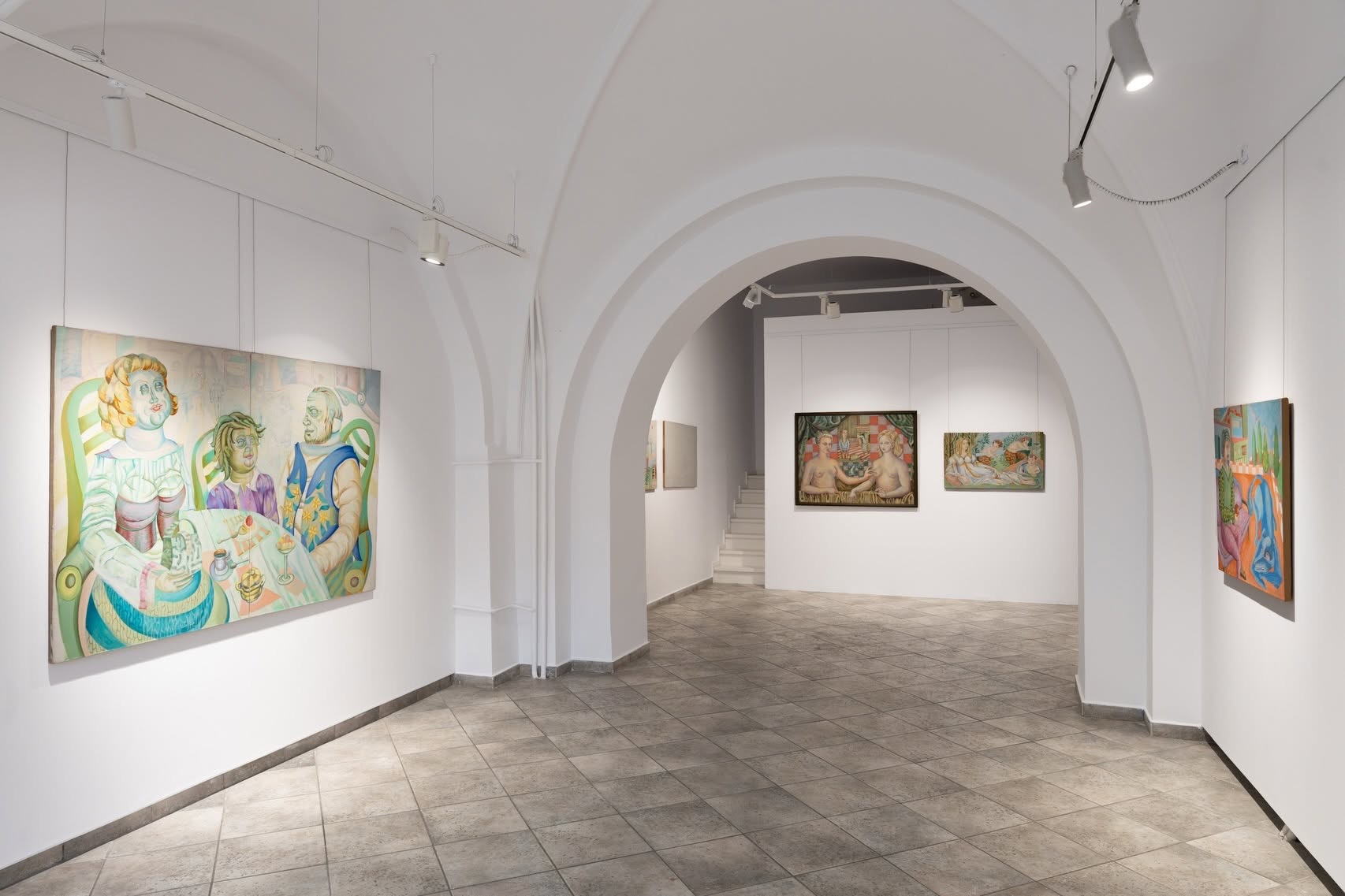
The artist (1971–2014) died more than a decade ago, yet a number of her paintings remained in the family collection. A 1996 graduate of the Academy of Fine Arts in Wrocław, she was regarded as exceptionally gifted. Her paintings, while rooted in a realist convention, are at the same time works marked by a distinct individuality. They may perhaps be situated within the broadly understood figurative art of the 1980s and 1990s, yet her painterly practice already bears every mark of difference and self-sufficiency. Deeply engaged with the art of the past, she readily employed quotation, pastiche and a play with realist conventions.
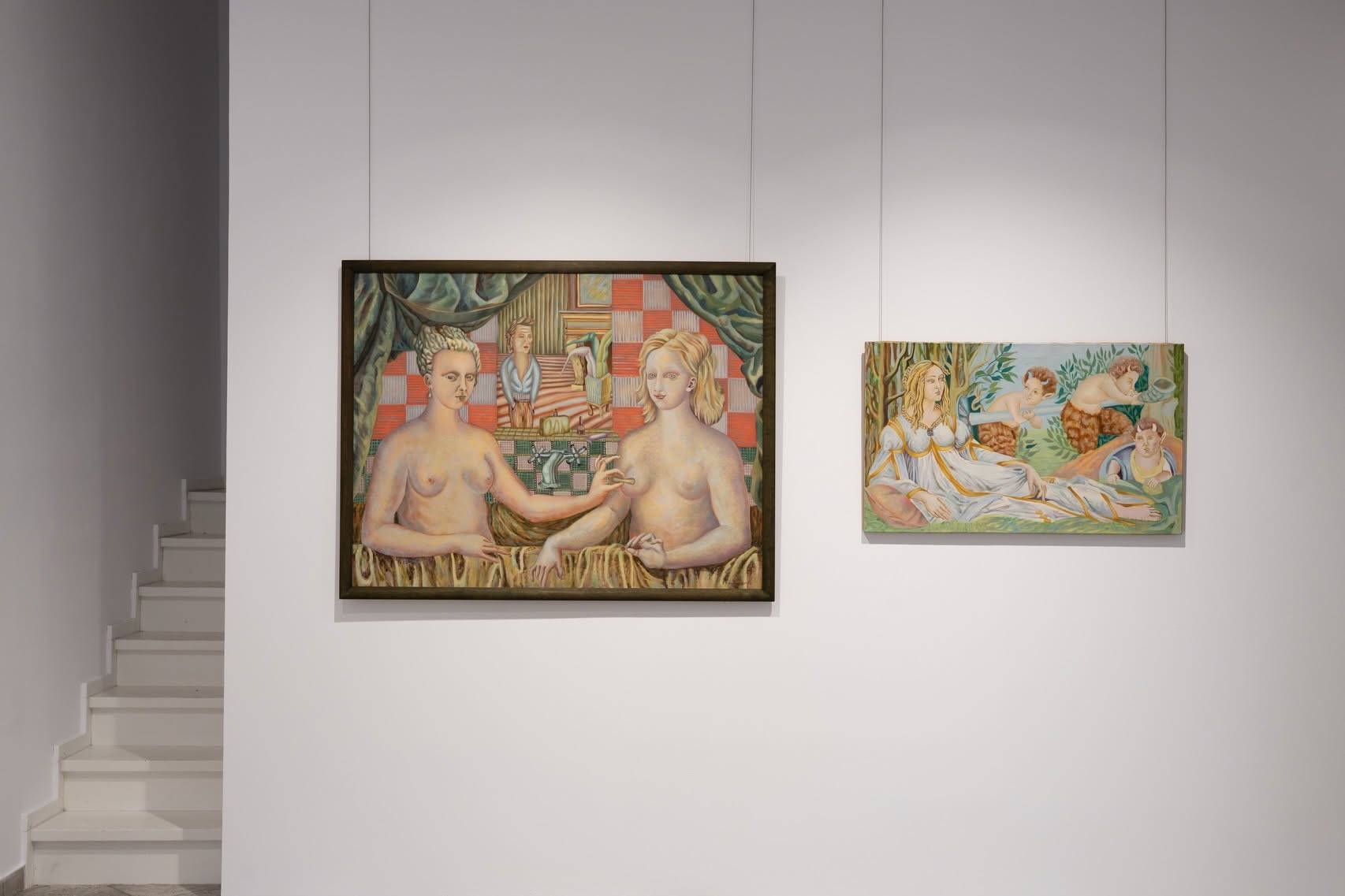
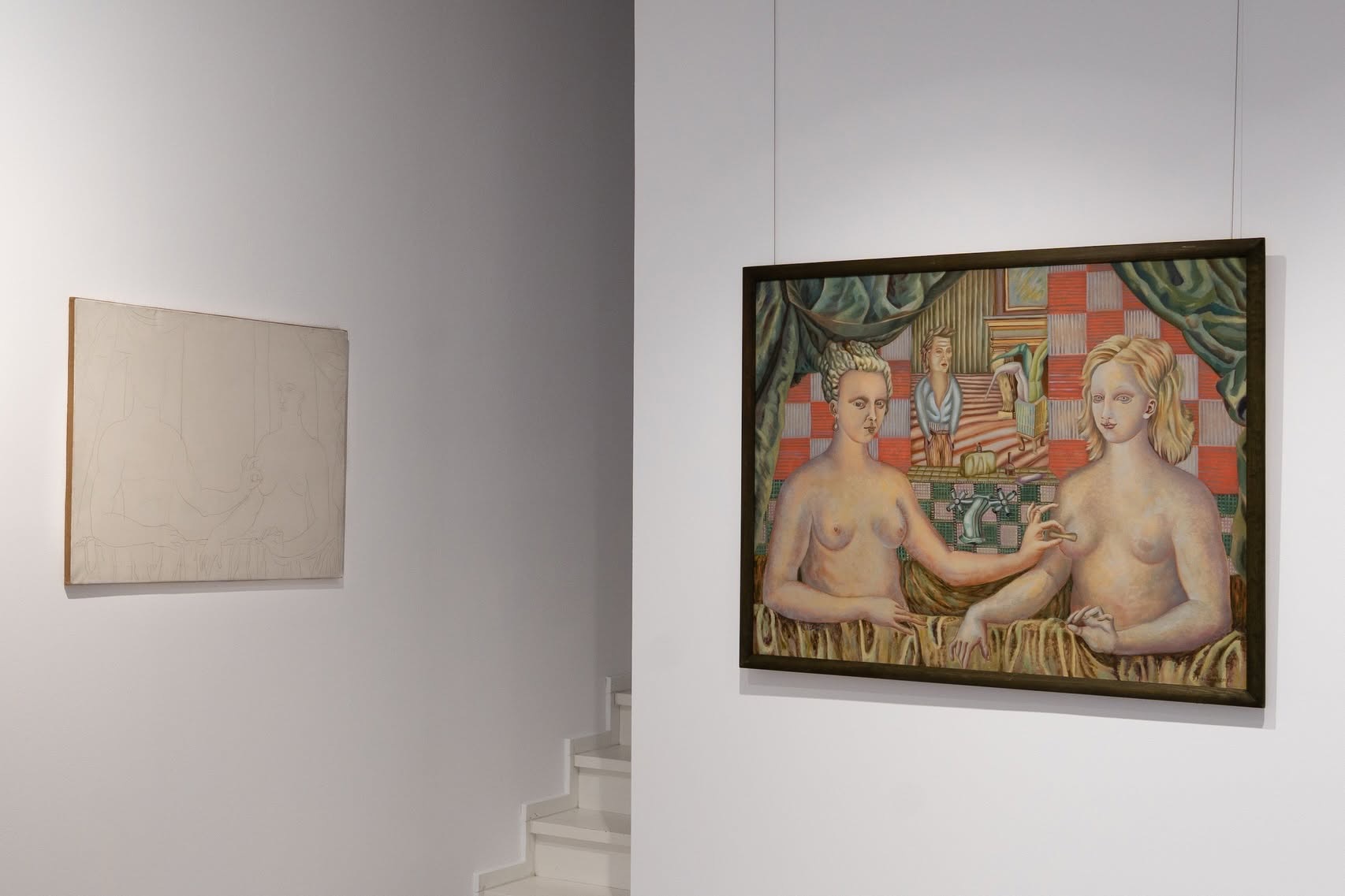
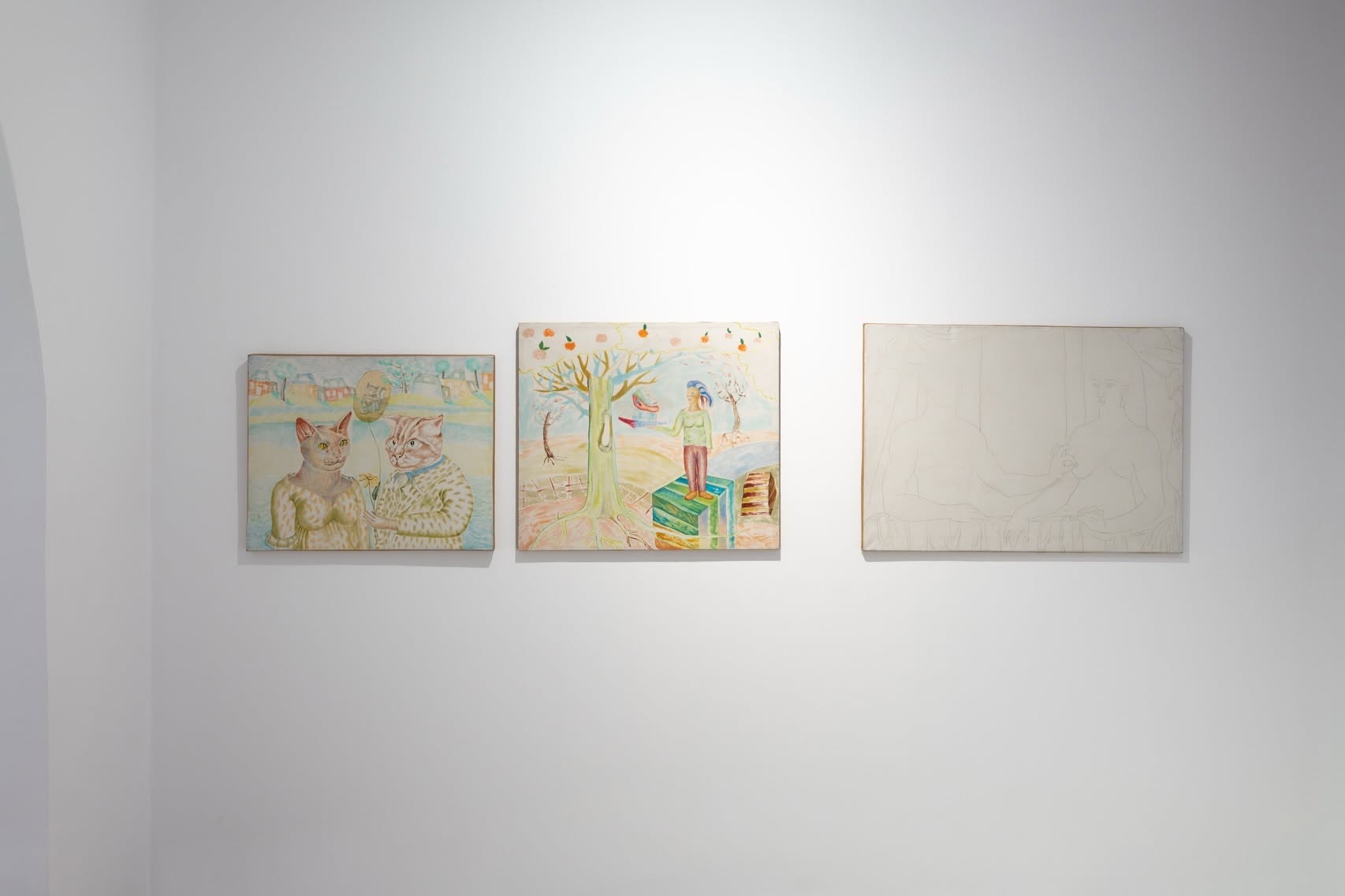
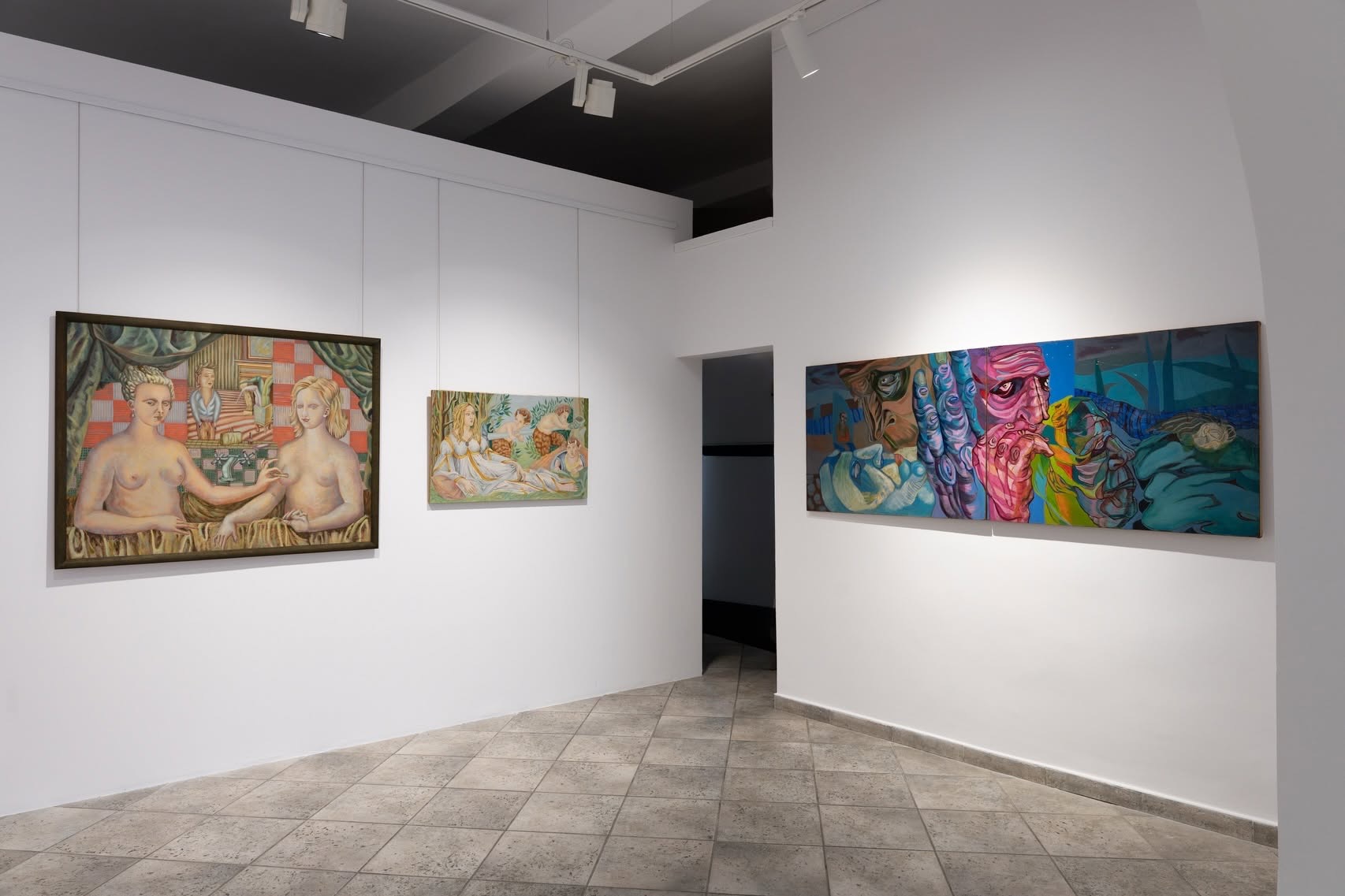
She created a paraphrase of Dürer’s famous Self-Portrait of 1500, as well as a copy of Vermeer’s A Maid Asleep in New York, but there is more. Botticelli’s Venus and Mars in London appears too – though without Mars – as does one of the most famous and erotically intriguing paintings in the history of art: the still-anonymous Gabrielle d’Estrées and One of Her Sisters, produced within the circle of the sixteenth-century French school of painting at the court of Fontainebleau. It depicts two elegant women bathing, one of them holding the other by the nipple. This utterly surprising gesture, virtually unique in the entire history of painting, is understood as an oblique indication that one of the women, the mistress of King Henry IV of France, is carrying his child. Dąbrowska draws on this motif in two of her compositions. There is also an unfinished pencil sketch for a new version of the painting, this time introducing a male figure. Perhaps she saw the original in the Louvre, where it is now held, or perhaps simply in a book. Her curiosity about – perhaps even fascination with – this painting reveals something of the particular interests of the Wrocław artist.
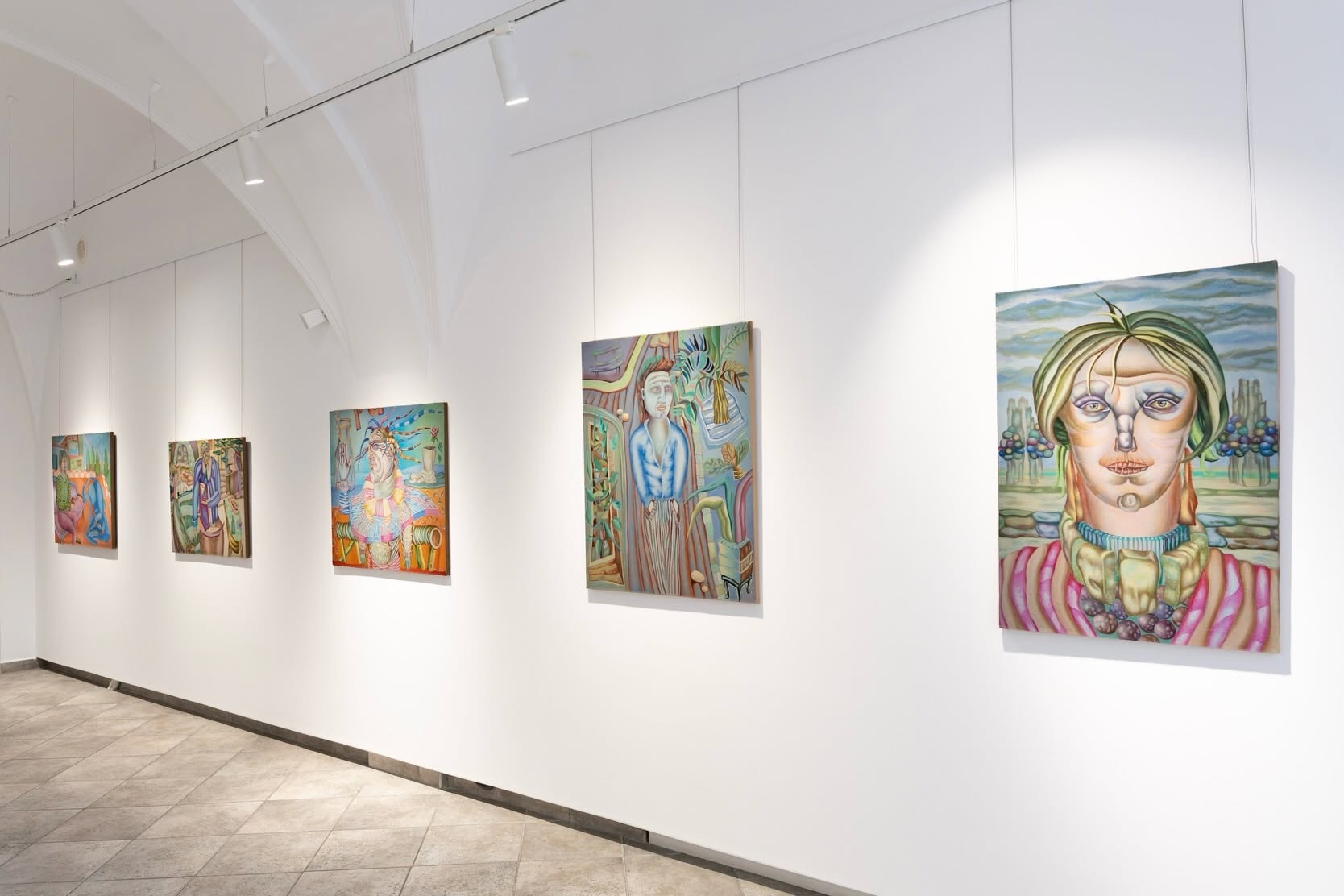
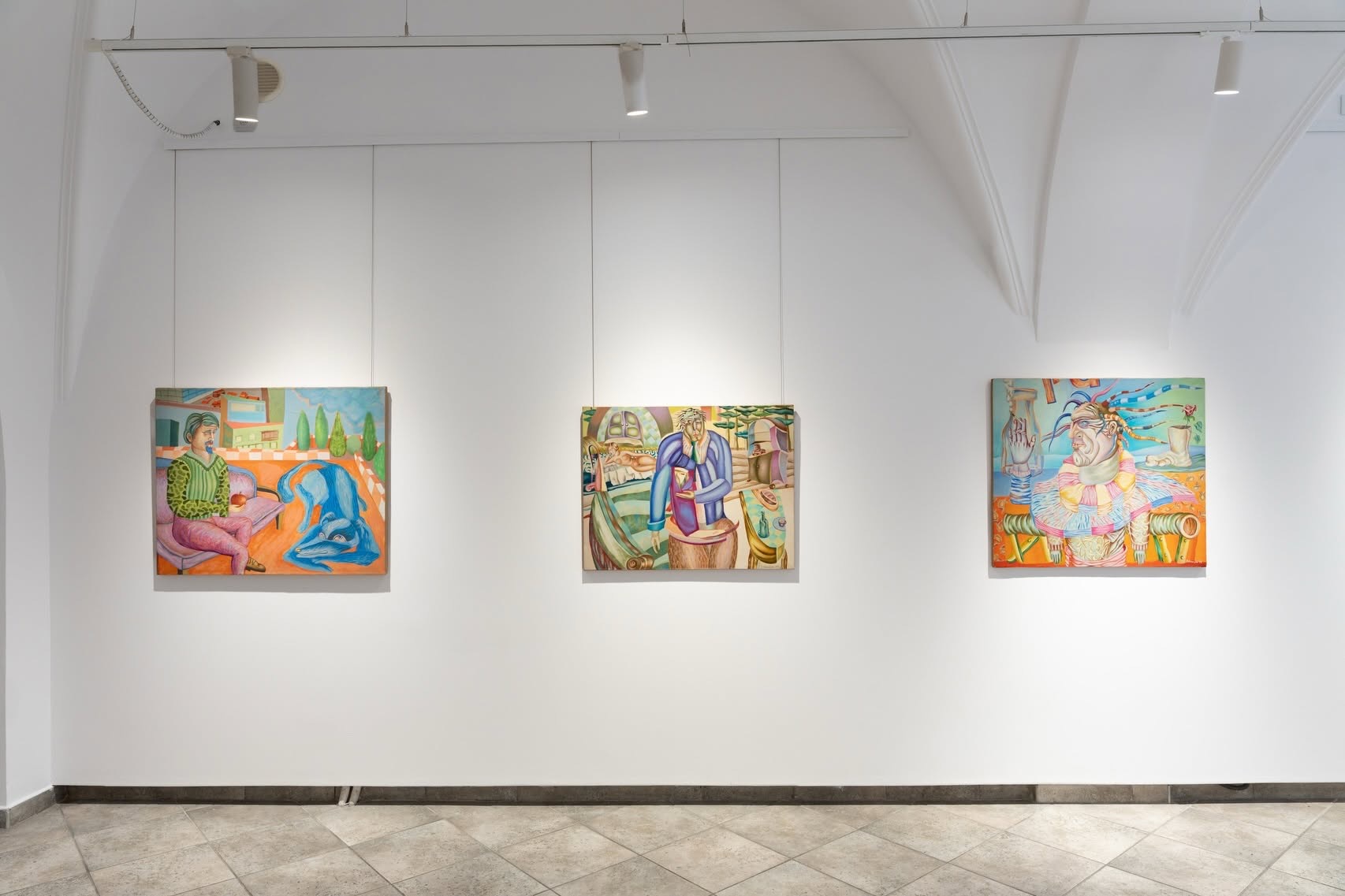
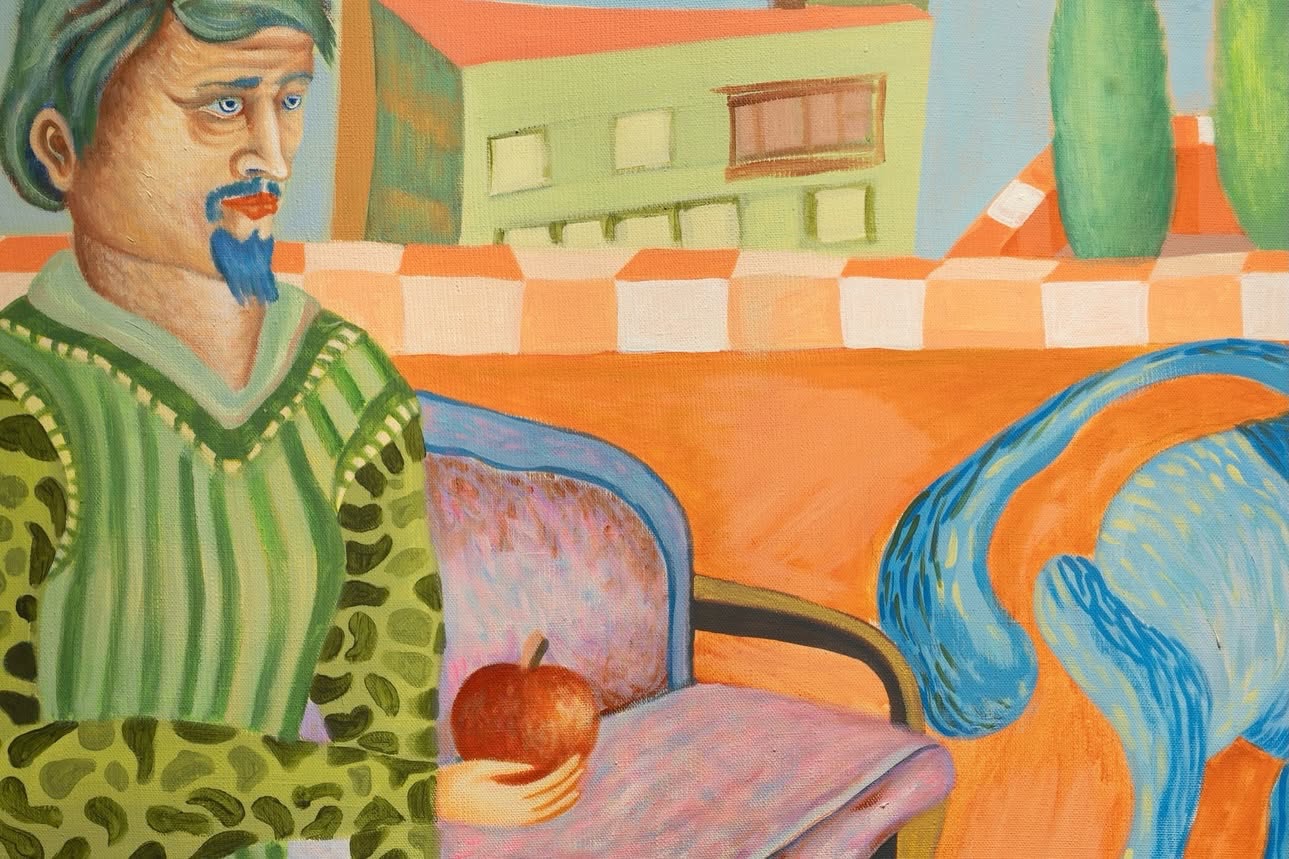
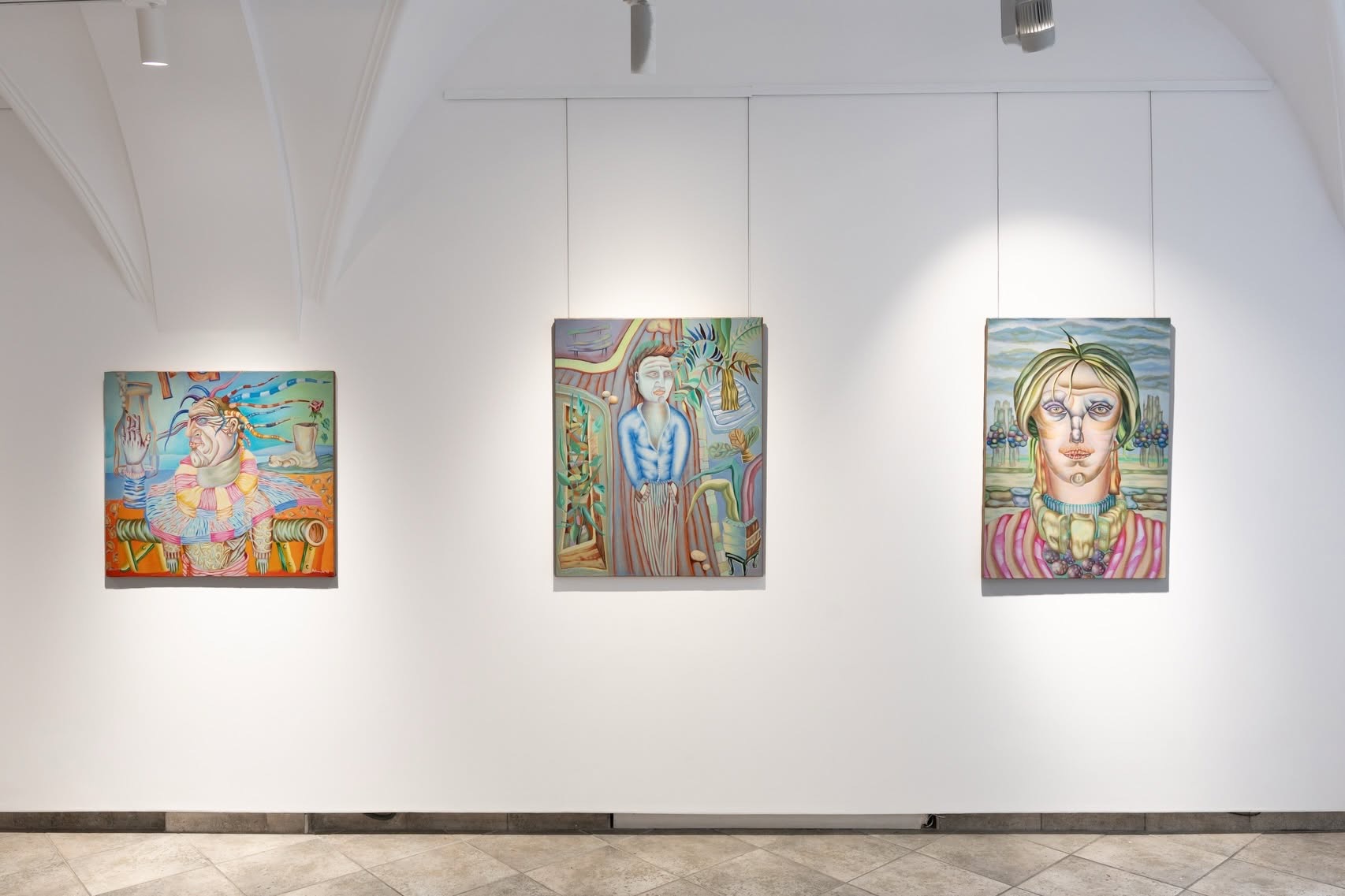
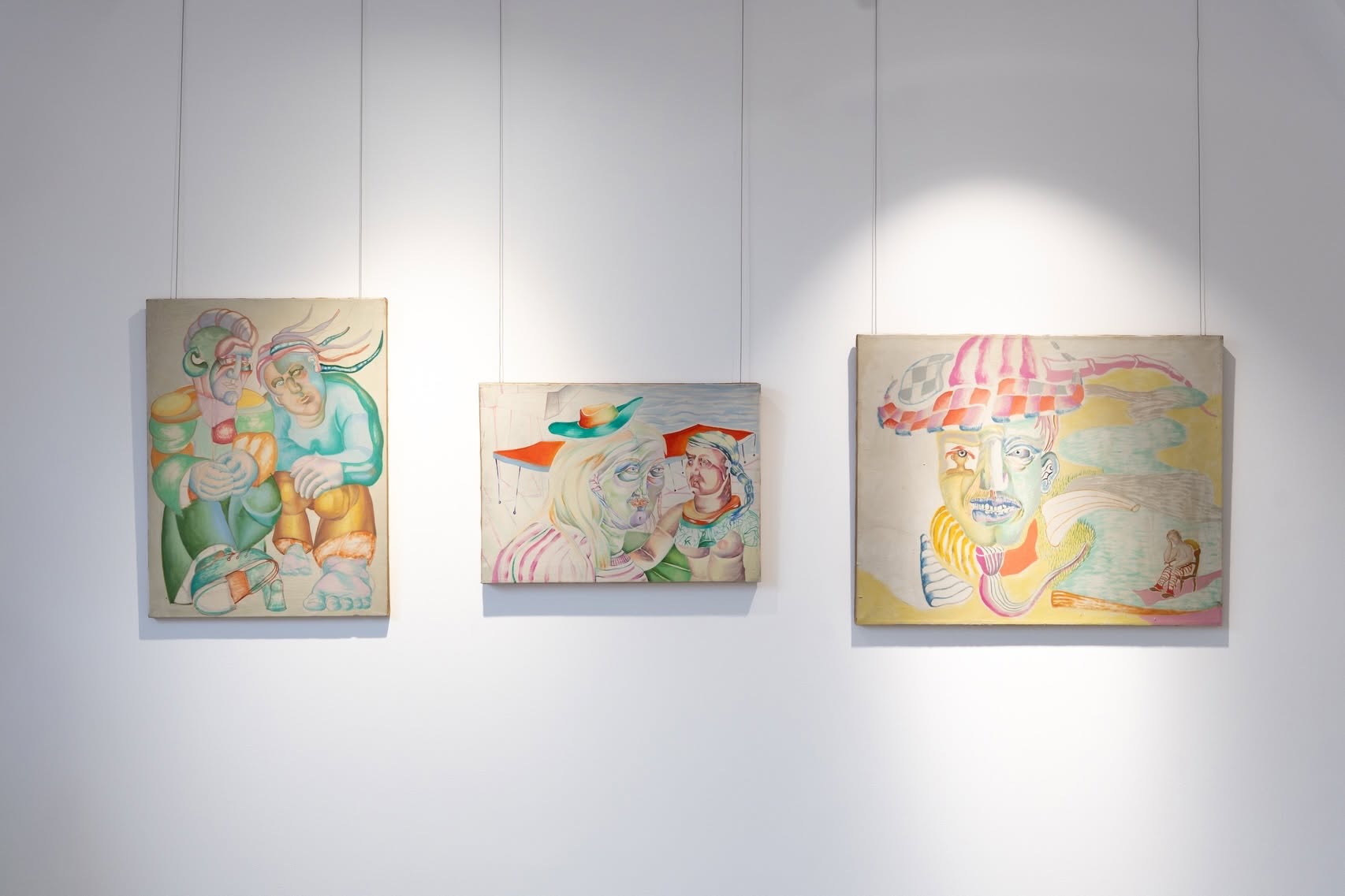
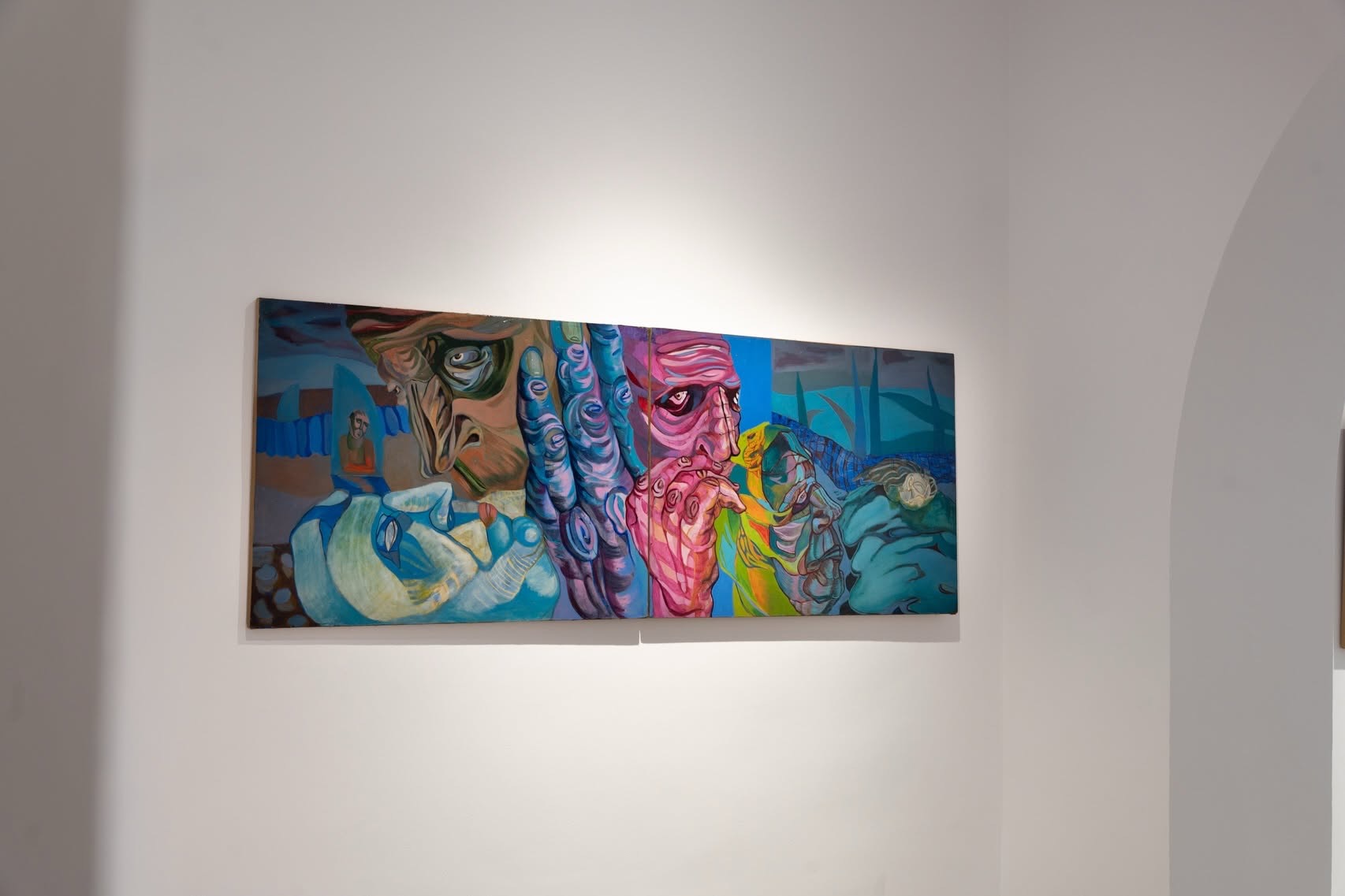
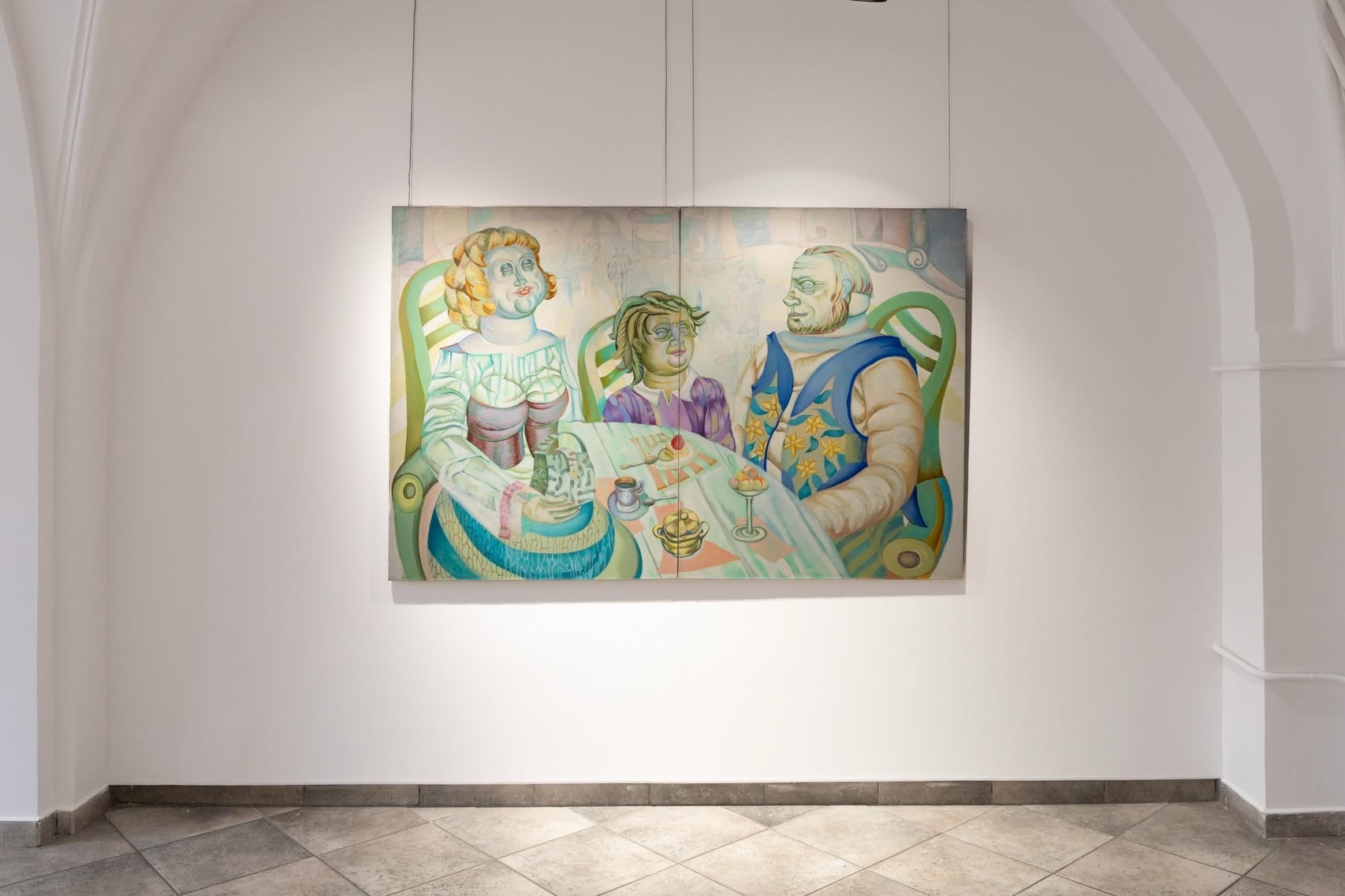
This can also be seen in her other compositions, generally rendered in vivid, contrasting colours – blues, greens, violets and pinks. Figures often have grotesque facial features, somehow out of scale and exaggerated, a little suburban perhaps, or rural, ambiguous.
Many of the paintings return to the motif of an enormous head, or several heads assembled out of abstract, additive components of some kind: a mouth cannot consist of just two elements; there are always many more, and it is virtually never otherwise. The same is true of noses, ears and eyes. Faces may be smoother, though by no means always. All manner of things happen to the anatomy of these figures as well, sometimes things that are downright bizarre. Invented forms, belonging to a fantastic rather than anatomical anatomy.
It is difficult to point to any single, unequivocal source of inspiration for these forms and for this way of constructing figures. The only thing that comes to my mind is the painting of the Soviet artist Pavel Filonov, who called his own intensified mode of painting “analytical art”. He broke elements of reality down into small, somewhat crystalline forms and used them to construct the forms in his paintings. Dąbrowska seems to proceed in a somewhat similar way, achieving comparable effects of a reality that has itself been analysed. What also unites the two is a fondness for the grotesque, for exaggeration. The Wrocław artist seems to continue both this method and this fragmentation of reality. The cool palette of her compositions likewise brings them close to the paintings of the Russian artist. Another resident of the city on the Oder, Waldemar Okoń, wrote appreciatively of Filonov, and it may have been through him that Dąbrowska encountered Filonov and his unmistakable aesthetic.
Does invoking a possible precedent in any way diminish her achievement? Absolutely not, for this method of painting is exceedingly complex, precise and time-consuming. To want to paint like Filonov is an almost mad and astonishing idea. What matters more is the creation of a world of one’s own, with its own, idiosyncratically conceived iconography, populated by figures and objects, but also by forms whose provenance is difficult to identify. Quite simply, we do not know what they are, where they come from, or what role they might play beyond generating unease – because we do not entirely know, and sometimes do not know at all, what they are or what part they have to play in this little world created by Dąbrowska.
It is difficult, in fact, to determine the origins of the exuberant imagination that fuels these compositions – so exaggerated, so vivid, so unlike anything else to be found in Polish art of the twentieth and twenty-first centuries. To point to Surrealism, which may also have provided one of the keys to these paintings, is entirely insufficient!
Perhaps some literature lies concealed here as well, though it is unknown to me. Clearly, I have not read those books; I have not wandered through the world that the Wrocław artist reveals in her paintings. I do not know those literary pages! Or perhaps there is no literature here at all, only phantasmagorical worlds created by the painter herself, who also worked in scenography, although I myself do not discern any scenographic threads in these works.
And so, to sum up: on the one hand, a vast and unfettered imagination of her own; on the other, inspirations drawn from the art of the past; and finally, most probably, the figure of Pavel Filonov. Yet it is also most likely only now that a conversation about her art will truly begin, along with the search for, and revelation of, the contexts in which it might be understood.
And thus, suddenly, onto the scene of Wrocław art steps a new personality – distinctive, full of character and utterly uncompromising. Dorota Dąbrowska deserves to be rediscovered, and her art, so singular and individual, deserves renewed recognition.
Bogusław Deptuła
Display